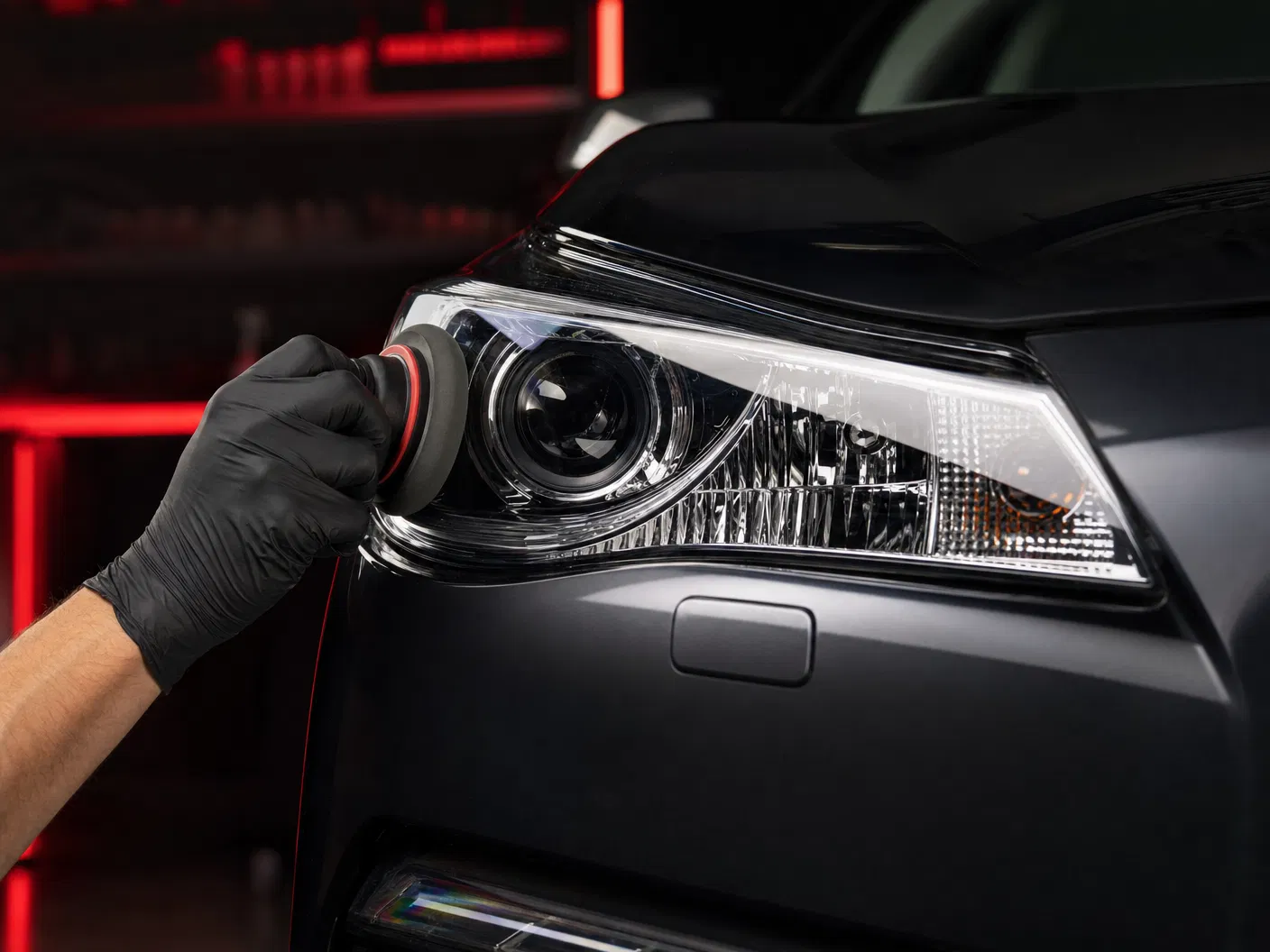
Car headlights usually turn yellow or cloudy when the weathered outer surface and protective hardcoat deteriorate. UV exposure is an important contributor, while heat, abrasion, contamination and maintenance history also influence the result. Some cloudy appearances are internal, so the lamp must be inspected before restoration is recommended.
Polycarbonate and Its Protective Surface
Polycarbonate is widely used for headlamp covers because it combines transparency with impact resistance and design flexibility. Unprotected polycarbonate is vulnerable to weathering, so manufacturers use protective surface systems. Once those systems deteriorate, the lens can lose clarity and develop yellowing, haze, roughness or coating failure.
Calling every case “oxidation” is convenient but incomplete. Visible deterioration may involve photochemical weathering, worn or delaminating hardcoat, micro-abrasion, embedded contamination or fine cracking. The practical point is the same: washing cannot remove material damage.
Why One Headlight Can Look Worse
The two sides may not have identical exposure or history. A previous replacement, accident repair, parking orientation, local heat, washer-fluid overspray or earlier polishing can make one lens age differently. Uneven yellowing does not prove a single cause.
External Haze Versus Internal Problems
External deterioration often feels rough or shows a clear weathered boundary and may respond to controlled restoration. Internal misting, water droplets, reflector damage or dirt inside the unit will not be corrected by polishing the outside. Fine crazing within the material may also remain visible after surface correction.
Does Yellowing Affect Lighting Performance?
Severe haze can scatter or reduce useful light and make the beam image less distinct. The effect cannot be judged reliably from appearance alone: bulb condition, lamp design, aim, voltage and internal optics also affect performance. Restoration can improve an externally degraded lens, but it is not a substitute for diagnosing a weak or defective lighting system.
Can Yellowing Be Prevented?
No treatment stops ageing permanently. Sensible measures include gentle washing, avoiding aggressive household chemicals, dealing with contamination promptly, and using a compatible protective system after restoration. Product claims should be tied to the named product and its documentation rather than converted into a blanket lifetime promise.
Frequently Asked Questions
Is yellowing just dirt?
Usually not. If normal washing does not improve it, the surface system itself may be degraded.
Can toothpaste restore headlights?
It may create a short-lived cosmetic improvement because it is mildly abrasive, but it is not a controlled refinishing and protection system.
Why is only one headlight cloudy?
Different exposure, prior replacement, repair history or internal condition can explain the mismatch.
Can a cloudy headlight always be restored?
No. External deterioration is the best candidate. Structural, internal or electrical faults need a different repair.
Does restoration make a lamp exactly new?
It can substantially improve a suitable lens, but existing chips, deep crazing and internal defects may remain.
We use cookies to make this site work. With your consent we'd also like analytics cookies, to see how visitors use it. See our Cookie Policy for details.