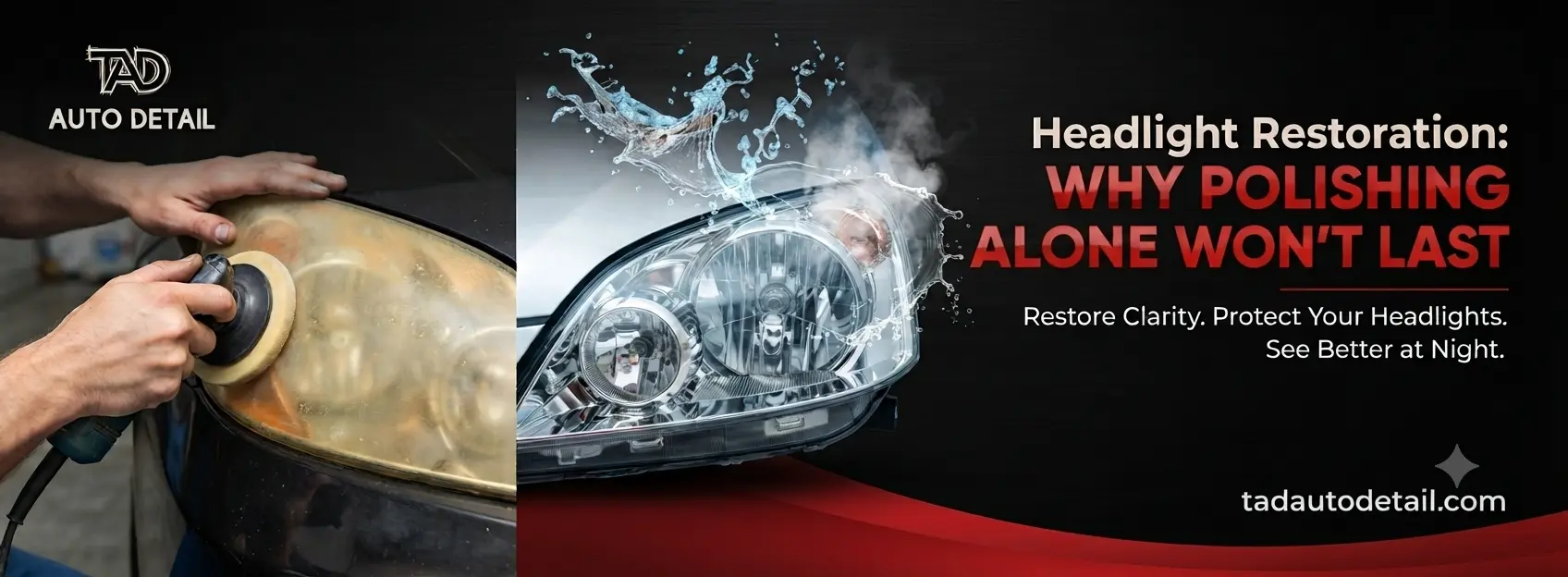
1 Why Headlights Go Yellow in the First Place
Modern headlight lenses are made from polycarbonate, not glass. It's a tough, lightweight, impact-resistant plastic — but it has one major weakness: constant exposure to UV light breaks down its surface structure over time. That's what causes the yellowing, hazing, and dullness you see on almost every car over five or six years old.
Manufacturers apply a thin UV-resistant clear coat to new headlights to slow this process down. But that factory coating is only a few microns thick, and once it wears through — from washing, road grit, weather, and years of sun — the bare polycarbonate underneath is exposed directly to UV radiation. From that point, oxidation accelerates fast.
2 What Polishing Actually Does — and What It Doesn't Do
Wet sanding and machine polishing removes the oxidised, yellowed layer of polycarbonate and brings the clear layer underneath back to the surface. Done properly, this genuinely works — it's not a cosmetic trick, it's a real mechanical restoration of the lens.
But here's the part that catches people out: polishing removes material. It doesn't replace the UV-resistant coating that protected the lens in the first place. Once that coating is gone and the fresh polycarbonate is left bare, it is more exposed to UV than before, not less. Without a new protective layer on top, oxidation can start again within a matter of months, especially on cars that are parked outside or driven often in direct sun.
- Polishing alone removes the yellowed layer — it doesn't seal or protect what's underneath
- Bare, freshly polished polycarbonate has no UV barrier at all
- Re-yellowing after a "polish only" service commonly starts within 3–6 months
- Each time this happens, a thin layer of the lens is sanded away — it can't be repeated indefinitely
The Honest Version
If a detailer polishes your headlights and sends you on your way with no topcoat, you've paid for a result that's already on a clock. It will look fantastic in the driveway and disappointing again well within a year. This isn't a scare story to sell you something — it's simply how UV-exposed plastic behaves once its protective layer is gone.
3 What Actually Makes It Last
The fix is straightforward: once the lens has been restored to full clarity, it needs a new protective layer applied immediately, before the bare polycarbonate is exposed to UV again. There are two ways to do this, and they suit different situations:
- UV Ceramic Coating — a hard, glass-like layer bonded to the polished lens. Meaningfully extends the result and adds gloss, but is not physical film and can't self-heal from stone chips.
- Headlight PPF — a physical, self-healing film applied over the restored lens. Blocks UV directly, and also protects against stone chips and micro-scratches that ceramic coating alone can't prevent.
This is exactly why, on every restoration we carry out, a UV Ceramic Coating is included as standard rather than offered as an optional extra — a polish with nothing on top isn't a finished job in our view. For anyone wanting the strongest, longest-lasting result, restoring the lens first and then applying PPF over the top is the combination we recommend most.
Already got yellowed or hazy headlights? We'll restore the clarity and protect it properly — at your home or driveway, anywhere within 5 miles of North Wembley.
Get a Quote on WhatsApp